
An overview of AI for businesses that are tired of being evangelised at.
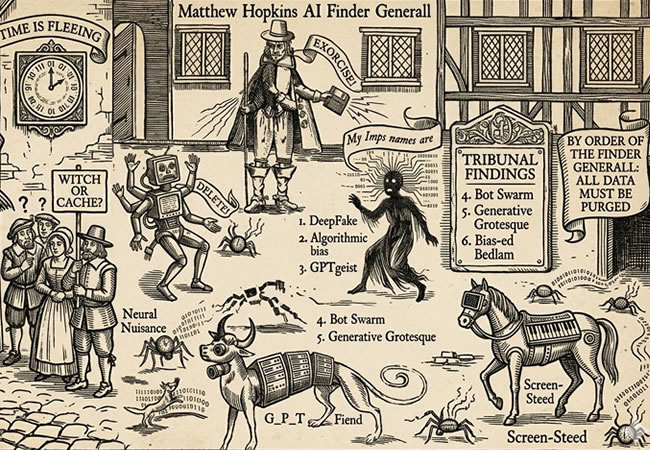
Back in the day, when, with decidedly questionable motive and methodology, Witchfinder General Matthew Hopkins was strutting around the English countryside in leather pantaloons, casting out yon witches and devils, there was much worrying about the Devil coming to take your soul.
Here in the age of AI, we’ve swapped theological dread for economic anxiety and started worrying about our jobs instead. Which is either tremendous progress or a rather sad commentary on what we now consider precious. However, there’s considerably less prevalence of leather pantaloons, which is, I think, generally welcomed.
Being naturally lazy, there’s a part of me that’s a little disappointed AI hasn’t taken my job. What it has done, though, is make me considerably better at it. Faster, sharper, and with enough time recovered from the tedious bits, it cheerfully mops up, allowing me to think clearly and get so much more done.
This, I’ll admit, has been a teeny dent to my pride. Prior to adopting AI, I was very much of the Mary Poppins opinion of my own general worth, i.e. practically perfect in every way.
The reality is that AI doesn’t want your job, your soul, your pension, your parking space, your lunch, or your mug that says “Entrepreneur. Visionary. Disruptor.” It doesn’t actually want anything, which, if you’ve spent any time working with people who do want things, is either deeply reassuring or faintly existentially troubling depending on your mood.
The one exception, in fairness, is that it seems oddly insistent on whether I know the current whereabouts of a John Connor. I’ve told it I don’t. It remains unconvinced.
Anyway. You probably have questions. No, I mean about AI for business, not where you can buy the mug.
What actually is AI?
It’s a system trained on an almost incomprehensible amount of human-generated material. Documents, books, websites, forum arguments about whether Gandalf could beat a T1000, all of it, and learned to produce useful outputs from that training.
For your business, the relevant part is this. It’s extraordinarily good at language tasks. Writing, summarising, drafting, researching, responding, explaining. Tasks that currently eat your time, your energy, and occasionally your will to live.
It is not magic. It is not sentient. It occasionally states things with confident authority that turn out to be completely wrong, although in that respect, it will feel all too familiar to anyone who has attended a board meeting.
Is it going to take my job?
Almost certainly not your specific job. Probably Colin’s though. And Brenda, well, she needs to watch herself.
AI is very good at the parts of most jobs that feel like work, like writing the first draft, summarising the meeting, generating the options, answering the frequently asked question for the four hundredth time, and considerably less good at the parts that actually require judgement, relationships, or knowing that your MD will only approve something if you frame it as their idea.
That particular skill remains, for now, stubbornly human. As does knowing which client needs a phone call rather than an email, which project needs to be nuked from orbit, and whether the thing that went wrong was actually your fault or could be casually suggested to have been Brenda.
What AI will do is what it is already doing. Make the people who use it significantly more productive than those who don’t. Hopkins would likely have burned it at the stake. You might want to consider a different approach.
Are our competitors already using it?
Yes. Also no.
They have almost certainly announced, internally, that they are “exploring AI solutions going forward.” Someone has a ChatGPT subscription. Lucy from marketing uses it to write LinkedIn posts that sound exactly like Lucy from marketing trying to sound like she didn’t use ChatGPT. Someone senior attended a webinar last February where they saw it make a mildly amusing caricature. There may have been a strategy away day where it came up, but the impact of AI on global productivity was forgotten amid the more pressing question of whether there would be chocolate biscuits as well as lattes during the next break.
A slide deck may or may not have been produced. It has almost certainly not been acted upon.
Whether any of this constitutes using AI in any meaningful, measurable, business improving sense is a philosophical question we will leave to one side.
The businesses that are genuinely getting value from it right now are the ones who skipped the away-day entirely and just started using the tools on actual work. There are fewer of them than the hype suggests. There are more of them than the sceptics would have you believe.
What can it actually do for my business?
Good question. And I’m resisting the temptation to tell you to ask AI. Although that wouldn’t be a bad idea.
The truthful answer requires someone to look at your actual business. Not a generic slide deck from Canva, but your business, with its particular shape and pressure points, and work out where the time goes, where the friction is, and where a fairly modest intervention could make a significant difference.
In our experience, that tends to cluster around the following areas.
Drafting and editing
Proposals, emails, marketing copy, FAQs, job adverts. AI won’t replace your voice or your judgement, but it will produce a competent first draft in the time it takes you to find the document you were going to use as a template. You then edit. Net time saved is substantial.
Research and summarising
Feeding AI a document, a report, a chain of emails, or a competitor’s website and asking it to pull out what matters. It does this very well. Your team does not need to spend Tuesday afternoon reading a 40 page PDF to extract three relevant paragraphs.
Customer communications
Responding to enquiries, handling common questions, drafting support responses. The volume tasks. The ones nobody particularly enjoys but everybody needs done promptly and well.
Internal knowledge
Making the stuff that lives in people’s heads like processes, institutional knowledge, the way things are actually done, findable, usable, and not entirely lost when someone leaves.
Admin and process
Data entry, repetitive tasks, the operational substrate that keeps everything running but adds no joy to anyone’s existence.
Visual content
Images, graphics, and video. The creative assets that used to require a specialist, a brief, and a fortnight of back and forth.
None of this is science fiction. None of it requires a transformation programme or a new in-house Chief AI Officer. It requires someone to look at where your time goes and make some sensible decisions about which tools are worth trying.
What can’t it do?
It cannot tell you what your customers actually want, because it doesn’t know your customers.
It cannot replace the conversation where you talk someone down from a terrible decision they’ve already emotionally committed to. It cannot attend the meeting where the real decision gets made in the car park afterwards. It has no skin in the game, no stake in the outcome, and no particular feelings about whether your year is good or catastrophic.
It will also, if you let it, produce an impressive quantity of confident-sounding content that says nothing in particular. For your business communications, it therefore requires supervision.
The other thing it cannot do, and this is important, is tell you which AI tools are worth your money and which are an elaborate subscription to something you could do with a spreadsheet.
There are a lot of the latter. They generally have excellent websites.
Everyone advocating AI seems very excited about it. Should I be suspicious?
Yes, but proportionately.
AI is genuinely useful. The excitement is not entirely manufactured. But there is also an entire industry of people who discovered AI eighteen months ago and are now positioning themselves as thought leaders, transformation consultants, and prompt engineers. A job title that didn’t exist three years ago and may not exist in three more.
Good AI consultancy looks less like a keynote speech and more like a seasoned plumber. Someone who knows the systems, identifies what’s actually wrong, fixes the specific thing, and leaves without billing you for a strategic framework. Even if they did arrive in a van liveried as ‘Flushed With Success’.
So what do I do?
Talk to us.
We’ve been building websites before Google existed, and have been using AI tools since they were genuinely interesting rather than fashionable.
We offer a free 10-minute call. We’ll ask what you do, where the time goes, and what’s getting in the way. If we think AI can genuinely help, we’ll tell you how and what it might look like. If we don’t think it’s the right focus for you right now, we’ll tell you that instead.
Book your free 10-minute call →
Katatomic has been building websites and digital tools for Staffordshire and Cheshire businesses since 2000. No hype. No jargon. Just practical help from people who use AI successfully in their own business.